Where 125cc Stops Being Enough in Northern Thailand
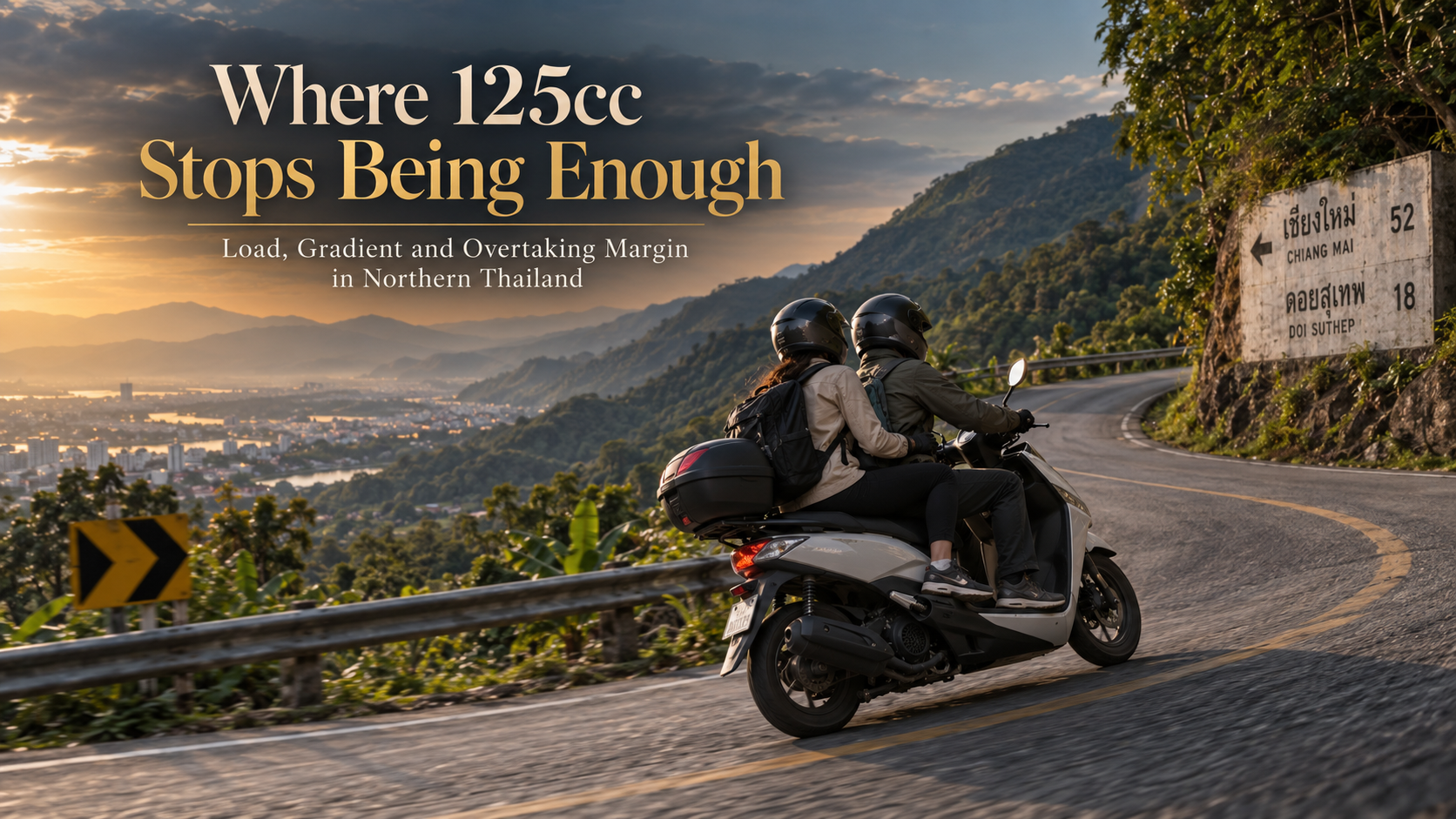
There is a standard answer you hear all the time in Chiang Mai: 125cc is fine for the city, 160cc is better for the mountains, and if you are planning a serious trip, take something bigger. It is not exactly wrong, but after years of watching different riders take the same scooters onto the same roads, I think engine size on its own is a poor way to make the decision.
A 125cc scooter with a 60 kg rider travelling around Chiang Mai is doing a completely different job from the same scooter carrying two adults and a top box up a long mountain road. The engine has not changed, but the workload has. That is the part usually missing from the simple “125 or 160?” discussion.
The scooter is only part of the weight
Take a typical modern 125cc scooter weighing a little over 100 kg. Put a 75 kg rider on it and the total moving mass is already around 175–180 kg before you have added luggage or a passenger.
Now add a 65 kg passenger and 10 kg of luggage. The same engine may suddenly be moving roughly 250 kg instead of 175–180 kg. In other words, you have increased the total mass by around forty percent without adding a single cubic centimetre of engine capacity.
This is why I do not particularly like statements such as “a 125 can do Doi Suthep” or “a 125 can ride the Mae Hong Son Loop.” Of course it can. A mechanically healthy small scooter can climb a surprising amount of road. The more useful question is what performance remains while it is climbing.
Climbing is not the same as climbing comfortably
On a flat road, most of the engine’s available output can be used to maintain speed and accelerate. Once the road becomes steep, some of that output is already being used simply to lift the combined mass of the scooter, rider and luggage uphill.
The relationship is straightforward. The heavier the total combination and the steeper the gradient, the more power is required just to maintain the same speed. A solo scooter-and-rider combination of roughly 177 kg travelling at 40 km/h on a 10 percent gradient requires about 1.9 kW simply to overcome gravity. Increase the total mass to around 250 kg and that figure rises to roughly 2.7–2.8 kW before aerodynamic drag, rolling resistance and drivetrain losses are even considered.
Those numbers are not meant to predict the exact speed of a particular rental scooter. Real roads constantly change gradient, rider weights vary, transmissions behave differently and no two engines deliver exactly the same real-world output. What the calculation does show very clearly is why adding a passenger can change the character of a small scooter so much.
What disappears first is acceleration reserve
In practice, the first sign that a 125cc scooter is reaching its useful limit is usually not that it refuses to climb. It is that there is very little acceleration left once you are already moving uphill.
A scooter may hold 45 or 50 km/h on a climb, but if the throttle is already close to fully open there may be almost nothing left when you need another 15 or 20 km/h quickly. That matters when you are following a slow pickup, songthaew or truck and finally get a reasonably clear opportunity to pass.
This is why I judge small scooters by acceleration reserve rather than by whether they can physically reach the top of the hill. “It made it up” is a very low standard. A better standard is whether the scooter still gives the rider useful options while doing it.
Northern Thailand makes this especially noticeable because road conditions can change quickly. You may have an easy flat section, then a long climb, then a short overtaking opportunity, followed by another steep section. A scooter that feels completely adequate for the first ten minutes can feel very different once most of its available performance is being used simply to maintain speed.
For Chiang Mai city, 125cc still makes perfect sense
None of this is an argument against 125cc scooters. For the right use, they are extremely practical machines.
A good 125 is light, easy to manoeuvre, simple to park and perfectly suited to stop-start riding around the Old City, Nimman, Santitham and the surrounding neighbourhoods. For a solo rider carrying little luggage and spending most of the time in town, moving to a heavier scooter can solve a problem that does not exist.
The calculation starts to change when several factors appear together: a passenger, luggage, sustained climbing and the expectation of maintaining normal open-road speeds. One of these factors alone does not automatically make a 125 unsuitable. When two or three of them appear together, the difference becomes much more noticeable.
125cc and 160cc are often different classes of machine
There is also more separating a typical 125cc scooter from a 155–160cc scooter than the displacement figure suggests. You are not simply comparing two engines with a small difference in cylinder capacity.
A typical lightweight 125 may use an air-cooled engine and a relatively simple chassis designed primarily for urban use. Scooters such as the Yamaha NMAX or Honda ADV160 combine their larger engines with liquid cooling, different transmissions, larger braking systems, different suspension and a heavier chassis.
That does not automatically make every 160cc scooter better. It means the machines are often designed around different operating expectations. The increase from 125 to around 160cc may look modest on paper, but on the road the entire package can feel substantially different.
This is also why simply comparing cubic capacity can be misleading. Two scooters with similar displacement may behave very differently depending on their weight, gearing, cooling system, tyres, brakes and overall design.
Where I stop treating 125cc as the default choice
For rental selection, I start looking beyond a 125cc scooter when several conditions appear at the same time.
A passenger is the first obvious one because the increase in total moving mass can be substantial. Regular mountain riding is another, especially when the route includes repeated or sustained climbs rather than one short hill. Open-road riding also matters because maintaining 40 km/h and accelerating from 50 to 70 km/h are very different demands.
The fourth factor is overtaking. A scooter does not need enormous top speed for Northern Thailand, but it does need enough reserve to respond when circumstances change. A machine that is already using most of its available output just to maintain speed gives the rider fewer options.
None of these factors creates a hard numerical boundary. A lightweight rider travelling solo may be perfectly happy on a 125cc scooter in situations where two heavier riders would find the same machine frustrating.
Choose for the difficult part of the trip
The rule I find most useful is to choose the scooter for the hardest part of the planned journey rather than for the easiest part.
Imagine that ninety percent of your riding will be easy roads in and around Chiang Mai. The remaining ten percent may be a mountain section with two people and luggage. If you choose the scooter entirely around the easy ninety percent, you may end up with a machine that is excellent in town and marginal exactly where the ride becomes demanding.
Choosing around that difficult ten percent does not mean automatically renting a 300 or 350cc scooter. Larger scooters bring their own disadvantages: more weight, more bulk and more effort at parking speeds. For someone mainly riding around Chiang Mai, that can be unnecessary.
The aim is not to rent the largest engine available. It is to make sure you still have some performance in reserve when the demanding part of the route begins.
For me, that is the point where 125cc stops being enough. Not when the scooter literally cannot climb the road, but when the combination of rider weight, passenger, luggage and gradient uses so much of its available performance that ordinary riding starts requiring compromises.
That is a far more useful threshold than the number printed on the side panel.