The First 15 Minutes of Rain in Chiang Mai: Where Grip Changes First
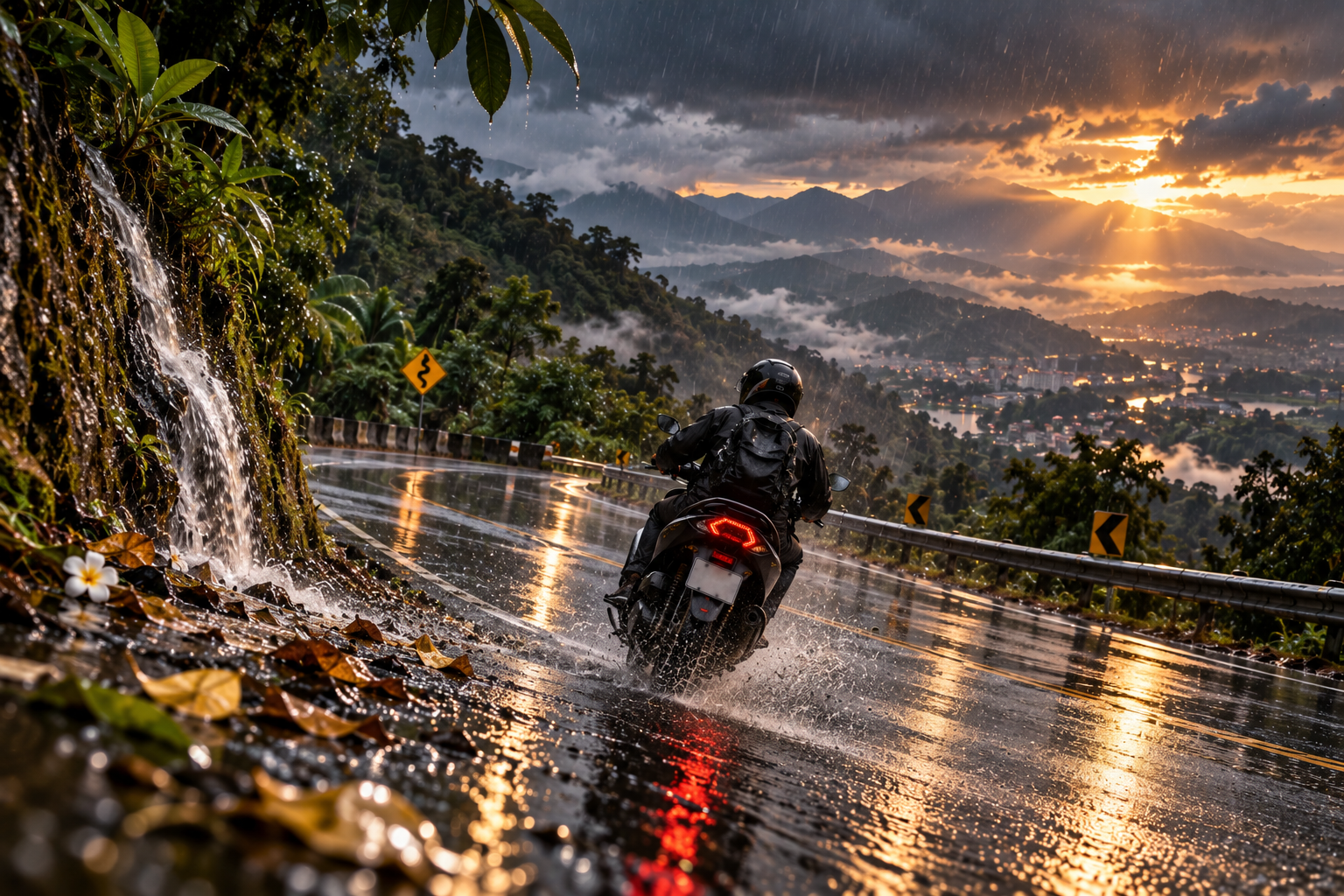
Most wet-weather riding advice starts with speed: slow down, leave more distance, brake earlier. None of that is wrong, but it misses what makes the beginning of a rain shower unusually awkward on a scooter. The road does not simply move from “dry” to “wet” and lose the same amount of grip everywhere. It becomes a patchwork of surfaces that are changing at different rates.
Thai road-safety guidance specifically warns about the first 10–15 minutes after rain begins. The reason is simple: the first water mixes with oil residue, dust and other contamination already sitting on the road before continued rainfall starts washing some of it away.
For a scooter rider, the useful way to think about those first fifteen minutes is not “the road is slippery.” It is to look for the places where the tyre is about to move from one surface condition to another. That is where a road that felt perfectly normal three metres earlier can suddenly feel very different.
The first rain creates a transition surface
After several dry days, traffic has had time to leave dust, fine debris and oily residue on the road. The first rainfall wets that material before enough water has fallen to move much of it elsewhere.
That explains something riders sometimes notice without understanding why. A light shower can feel unexpectedly poor even when there is almost no standing water and visibility is still excellent. The amount of rain is small, but the surface is changing quickly.
Once the rain has been falling for longer, the situation changes again. Some surface contamination may have been washed away, while water depth, spray, mud and visibility become more important. There is no magic moment at fifteen minutes when the road becomes safe; the dominant problem simply shifts.
This is why a generic instruction such as “ride 20 or 30 percent slower in the rain” is not particularly useful. The same speed can be comfortable on wet asphalt and completely wrong a few seconds later if the scooter reaches a broad road marking while braking.
Five transitions are worth watching
On a scooter, I would pay more attention to these changes in surface than to the fact that rain is falling at all.
Dry asphalt to newly contaminated wet asphalt. This is the transition behind the first-10-to-15-minute warning. The road may still look almost normal while water is mixing with accumulated residue.
Asphalt to thermoplastic road marking. Lane lines, arrows, stop bars and pedestrian crossings can have different wet-friction characteristics from the road around them.
Asphalt to smooth metal. Utility covers, drain covers and temporary plates change the contact surface abruptly and give the tyre very little texture to work with when wet.
Clean asphalt to runoff carrying fine material. On sloping and mountain roads, water can bring soil, leaf material and small debris onto the carriageway, creating a layer between the tyre and the asphalt.
Visible road to opaque standing water. Once you can no longer see the pavement underneath, you have lost information about both the surface and its depth.
These are five different problems. Treating all of them as simply “a wet road” hides the useful part of the decision.
Road markings are more important than they look
Thailand commonly uses thermoplastic material for road markings. In practical terms, the tyre is often not simply crossing coloured asphalt. It is moving onto a separate applied surface sitting above the pavement.
That does not mean every white or yellow line is automatically dangerous. Surface texture, wear, installation and embedded glass beads all affect friction. Some markings are far better than others.
What matters is that the grip can change when the tyre moves from asphalt onto the marking.
A narrow lane line crossed upright on a straight road may pass almost unnoticed. A broad stop line reached while the front brake is loaded is different. So is a direction arrow positioned through the part of a bend where the scooter is already leaned over.
Junctions combine several of these transitions in a very small area. You may arrive on asphalt, brake across a stop bar, turn across an arrow or pedestrian crossing and then accelerate over another marking. In dry weather the differences may be insignificant. During the first few minutes of rain, this is exactly where an otherwise ordinary intersection can become less predictable.
The practical response is not to make a sudden correction when the tyre reaches the marking. It is to have already done most of the speed adjustment on the asphalt and cross the questionable surface with the scooter relatively settled.
Mountain runoff is a different kind of grip change
The city mainly presents manufactured transitions: asphalt, markings, concrete and metal. Outside Chiang Mai, especially on roads that cut through slopes, rain introduces another type of surface change because water itself can transport material onto the road.
The important visual clue is often not the amount of water but its colour.
Clear water flowing over dark asphalt tells you something different from a brown or pale film crossing the lane. If the water is carrying fine soil, the tyre may no longer be in direct contact with the road surface you saw on the approach. Leaves collecting along the flow are another useful sign that the water is moving material rather than simply draining across clean pavement.
This can make a familiar road inconsistent within a very short time. A bend ridden on clean asphalt before the shower may have a thin layer of silt across it on the way back. Nothing about the geometry of the corner has changed, but the contact surface has.
That is also why staring only at the line through the corner is not enough in the rain. The colour and texture of the pavement ahead become part of reading the road. A change from black asphalt to a lighter brown patch is information, even when the layer itself is too thin to judge from the saddle.
The same logic applies to standing water. The immediate problem is not necessarily aquaplaning. Dirty water can hide a pothole, broken pavement or a sharp edge that would have been obvious on a dry road. Once the road surface disappears from view, the rider is no longer making a decision with the same information.
The useful skill is separating tyre demands
A motorcycle tyre has to generate forces for braking, cornering and acceleration through the same small contact patch. When the available friction changes suddenly, asking for several of those things at once reduces the remaining margin.
This is the common feature linking the five transitions above.
If there is a broad thermoplastic arrow through a bend, slowing before it is more useful than trying to correct the scooter while already on it. If a metal cover cannot be avoided, crossing it with relatively neutral throttle and minimal lean asks less from the tyre than braking across it. If runoff has carried dirt over a mountain road, most of the useful decision should be made before the front wheel reaches the contaminated section.
The goal is not to ride rigidly upright every time the road gets wet. It is to avoid stacking a surface change, hard braking and significant steering input in the same metre of road when there is no reason to do so.
That also explains why two apparently similar wet sections can feel completely different. On one, the scooter is travelling almost straight and at constant speed. On the other, the rider is braking and turning at the exact point where the surface changes. The weather is identical; the demand on the tyre is not.
Fifteen minutes is a warning window, not a countdown
The first 10–15 minutes matter because they represent a specific phase of rainfall rather than some arbitrary number. During that opening period, the road is undergoing rapid changes that may not be visually dramatic.
After sustained rain, some of those initial contamination problems may reduce, but other hazards become more important. If rainfall becomes heavy enough that the road surface itself becomes difficult to read, the problem has moved beyond managing individual grip transitions.
At that point, stopping somewhere safe and waiting for conditions to improve can make more sense than continuing simply because the motorcycle is still moving.
For ordinary rain, however, the most useful habit is simpler. Do not treat the whole road as one wet surface. Look at what the front tyre will actually touch during the next braking or steering input.
In the first fifteen minutes around Chiang Mai, the difference between asphalt, a thermoplastic stop line, a wet metal cover and a strip of muddy runoff can matter more than the rain itself.