Why a Scooter Can Feel Fine in Chiang Mai and Weak in the Mountains
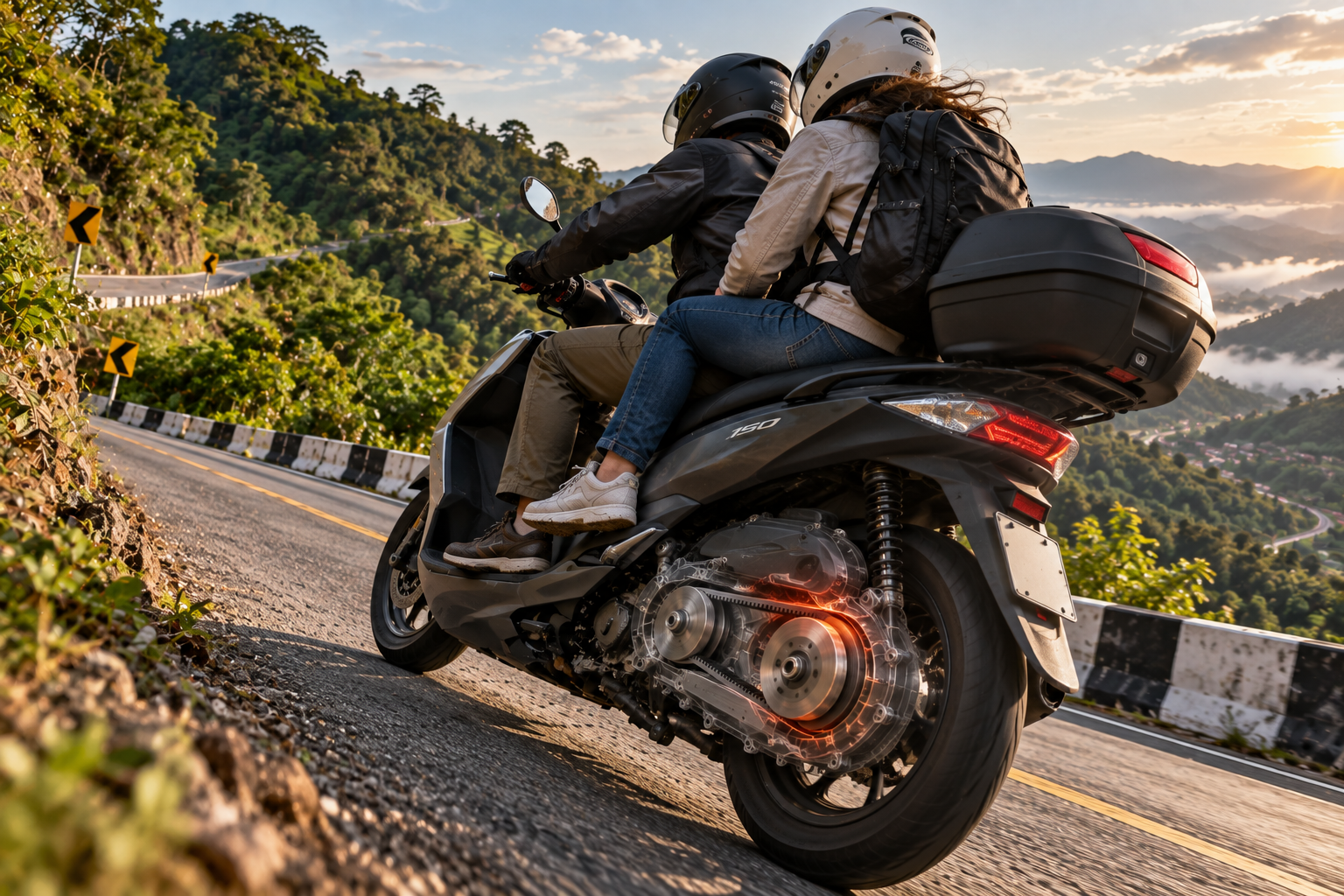
A scooter can feel completely normal during a short ride around Chiang Mai and behave very differently once it has spent some time climbing in the mountains. Around town it starts cleanly, pulls away normally and reaches traffic speed without anything obviously wrong. Later, with a passenger or luggage on board and the road climbing continuously, the engine may still rev freely while the scooter no longer accelerates the way it did earlier.
When that happens, blaming the engine first can send the diagnosis in the wrong direction. On an automatic scooter, engine power still has to pass through the CVT before it reaches the rear wheel. A transmission that works well enough during a short, light city ride can reveal marginal wear only after it has been hot and heavily loaded for a while.
That is one of the reasons a five-minute test around the workshop can miss a problem that a customer repeatedly experiences in the mountains.
Why the city test can be misleading
Chiang Mai traffic is not especially demanding on a scooter transmission. Speeds are moderate, the road is mostly flat, and the CVT spends much of its time accelerating briefly and then settling into an easier operating range.
A long climb is different. The transmission has to keep the engine in a lower effective ratio for much longer because more torque is needed at the rear wheel. Add another adult and some luggage and the load increases again.
The same scooter may therefore pass three very different tests:
- cold, with a light load;
- fully warm, still with a light load;
- fully warm after sustained riding under heavy load.
If the complaint only appears in the third situation, reproducing the first one tells you very little.
This is something that matters particularly in rentals. A customer may say, “It was fine in Chiang Mai, then after climbing for a while it became weak.” If the scooter is then ridden alone for a few minutes on flat roads and returned with “nothing wrong,” the original conditions were never tested.
The machine was reproduced. The workload was not.
“No power” can mean two very different things
Customers rarely describe mechanical faults precisely. They describe what the scooter felt like.
“The bike has no power” might mean the engine itself is struggling to produce rpm. Fuel delivery, ignition, air intake, engine temperature or mechanical condition can all cause that sort of behaviour.
There is another complaint that sounds similar but feels different from the saddle: the engine revs normally, sometimes quite strongly, but the increase in road speed does not match the increase in rpm.
That difference matters.
If the engine refuses to rev under load, the problem may be on the engine side. If rpm rises easily while acceleration becomes weak or vague, attention should also go to the transmission.
It does not prove that the belt is slipping. A worn clutch, damaged pulley surfaces, worn variator components or badly chosen aftermarket parts can produce related symptoms. But the rpm-to-road-speed relationship gives a much better starting point than simply saying the scooter “feels slow.”
For a rental fleet, that distinction is especially valuable because it can be recognised from a customer description before anything is dismantled.
Why heat can expose marginal CVT condition
The CVT on a typical automatic scooter is mechanically simple: a variator, belt, rear pulley and centrifugal clutch. Under load, however, those parts are doing continuous work and producing heat.
The belt is bending around the pulleys while transmitting torque. The variator is constantly adjusting ratio. The clutch and its bell can also generate substantial heat during slow-speed climbing, repeated starts on an incline or situations where the clutch remains partly engaged.
A healthy transmission is designed to tolerate this. A marginal one may behave normally while cold and begin to lose efficiency only after temperatures rise.
That is where short test rides become deceptive.
A worn belt may still transmit enough torque for normal city acceleration. A clutch may engage well enough when cold. A CVT cooling path that is partly restricted by dust may still cope with ten easy minutes in town. Put the same components under sustained load on a hot day and the margin becomes much smaller.
Northern Thailand is particularly good at exposing this because the conditions often combine several stresses at once: high ambient temperature, long climbs, dust, a passenger and luggage.
The problem does not need to appear suddenly. Often the rider simply notices that acceleration becomes progressively worse as the climb continues.
A belt can be bad before it is broken
CVT belts are often treated as binary components: good until they snap.
Wear starts much earlier than that.
As a belt wears, it becomes narrower. Because the CVT ratio depends partly on where the belt sits between the pulley faces, that change in width affects how the transmission operates. The scooter may continue to run for a long time while acceleration or cruising behaviour slowly deteriorates.
Repeated overheating can also harden or glaze the belt surface. Again, nothing dramatic needs to happen. The belt is still intact, but it may no longer transmit torque as cleanly under load.
The pulleys matter too. Installing a new belt into a transmission with worn or damaged pulley surfaces does not automatically return the whole system to new condition.
For diagnosis, however, there is no need to turn the article into a CVT repair manual. The important point is simply that transmission wear can remain almost invisible during light use and become obvious only when load and temperature rise together.
Mileage alone does not describe CVT life
This becomes a bigger issue in rental fleets because two scooters with identical odometer readings may have experienced completely different working lives.
One may have spent most of its time carrying a single rider around Chiang Mai. Another may have repeatedly carried two adults and luggage through steep mountain routes.
Both may show 20,000 km.
Those are not necessarily equivalent 20,000 km from the transmission’s point of view.
Mileage is still useful for scheduled maintenance, but it does not capture load history. A rental operator also needs to pay attention to how individual scooters are being used, whether complaints appear after sustained load, and whether the behaviour changes as the transmission warms up.
That matters because rental customers have no baseline. They do not know how the scooter accelerated 5,000 km earlier. If it starts, moves and feels acceptable around town, they naturally assume it is fine.
A workshop maintaining its own fleet has access to information the customer does not: service history, repeated complaints, previous belt inspections and patterns tied to particular routes or loads.
Ignoring that information and looking only at the odometer throws away one of the main advantages of maintaining a fleet yourself.
How I would reproduce the complaint
If a scooter is reported to become weak only in the mountains, I would not start by repeating another short city ride.
First, establish exactly what the rider experienced. Did the engine stop building rpm, or did the engine rev while the scooter stopped accelerating properly? Did the problem appear immediately or only after sustained climbing? Was the rider alone? Was there a passenger and luggage? Did the scooter return to normal after cooling?
Those answers already narrow the problem considerably.
Then reproduce the load as closely as practical.
A solo mechanic on a flat road is a poor test for a complaint that appeared with two adults on a long incline. If the scooter behaves normally when cold, test it fully warm. If it behaves normally when warm under light load, the next step is sustained load rather than another lap around the block.
This approach does not diagnose the exact failed component by itself. What it does is tell you whether the complaint is real and under what conditions it appears.
That is far more useful than declaring the scooter healthy because it accelerated normally for five minutes.
When engine size gets blamed for a transmission problem
Mountain riding already reduces the performance margin of a small scooter. A 125 or 160 carrying two people will naturally accelerate more slowly uphill than it does with one rider on flat ground.
That makes CVT problems easy to misread.
A worn transmission under heavy load can feel superficially similar to a scooter that is simply reaching the limits of its engine size. In both cases the rider hears high rpm and gets less acceleration than expected.
The difference is consistency.
A healthy scooter should behave predictably for its class. A heavily loaded 160cc machine may not accelerate hard on a steep climb, but its response should remain broadly consistent. If performance degrades noticeably as the transmission gets hot, or rpm starts rising without a proportional increase in road speed, the situation deserves closer inspection.
That is also why replacing the scooter with a larger model is not always the right answer. A healthy smaller scooter can be a better mountain machine than a larger scooter with a neglected CVT.
The mountain often reveals the fault rather than causing it
When a scooter becomes weak halfway through a climb, the route gets blamed because that is where the problem appeared.
Sometimes the route really is the whole explanation. The load is heavy, the gradient is steep and the scooter simply has limited performance available.
But sustained climbing can also expose a transmission that was already close to the edge.
That distinction matters in a rental fleet. If the same complaint appears repeatedly under similar load, the correct response is not another short ride around Chiang Mai and another conclusion that everything feels normal.
The test has to reproduce the conditions that make the problem appear.
A city ride tells you that the scooter works in the city.
It does not necessarily tell you what its CVT will do after sustained load in the mountains.